
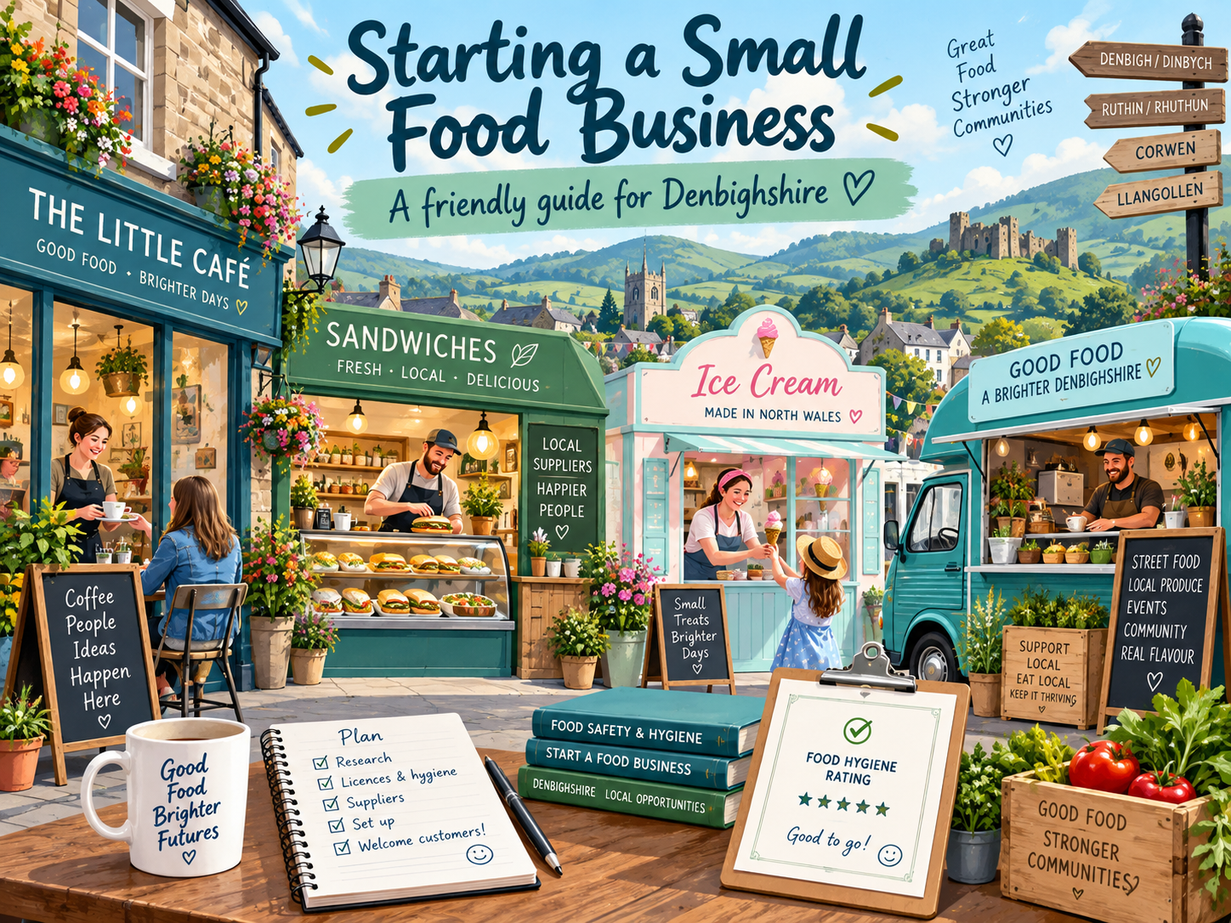
A friendly guide to cafés, sandwich shops, ice cream parlours, home food businesses and small food outlets
You have an idea. Perhaps it is a little café, a sandwich shop, an ice cream counter, a cake business from home or a stall selling the finest toasties Denbighshire has ever encountered.
Then comes the slightly less exciting question:
What do I actually need before I can legally sell food?
The good news is that starting a small food business does not require a suitcase full of mysterious certificates. There are important rules to follow, but most are there for sensible reasons: keeping food safe, protecting customers and making sure everybody knows what is being sold.
This guide is intended as a friendly starting point for somebody considering a food business in Denbighshire. It is not a substitute for advice from Denbighshire County Council, the Food Standards Agency, an accountant or another professional where appropriate.
1. Register your food business
This is the big one.
If you sell, prepare, cook, handle, store or distribute food as a business, you will normally need to register as a food business.
That includes:
- cafés
- sandwich shops
- restaurants and takeaways
- bakeries and cake businesses
- ice cream parlours
- market stalls
- food vans
- businesses operating from home
- businesses selling through Facebook, Instagram or a website
- delivery-only businesses
In Denbighshire, registration must normally be completed at least 28 days before you begin trading or before you take ownership of an existing food business. Registration is free.
Where do I register?
Use the Food Standards Agency/GOV.UK Register a Food Business service. Your registration is then passed to Denbighshire County Council.
And yes, your kitchen at home counts. Regularly preparing food at home for sale can make your home a food business premises and it may subsequently be inspected.
Registration should not be confused with registering a company or registering as self-employed. Those are separate things.
2. Do I need a Food Hygiene Certificate?
Here is one of the most common misunderstandings.
There is no general legal requirement saying every food handler must hold a Level 2 Food Hygiene Certificate.
The legal requirement is that food handlers receive appropriate supervision, information and training in food hygiene for the work they perform. The Food Standards Agency itself does not issue standard food hygiene certificates.
However, obtaining a recognised qualification is an excellent idea.
For someone preparing or serving food, a Level 2 Food Safety/Food Hygiene qualification is a sensible starting point. For somebody managing a kitchen or supervising several employees, Level 3 training can also be worthwhile.
It provides evidence that you understand issues such as:
- cross-contamination
- safe temperatures
- cleaning
- chilling
- cooking
- personal hygiene
- food storage
- pest prevention
Courses are available from numerous recognised training providers. Denbighshire’s Environmental Health/Food Safety team can also advise businesses about appropriate training.
So think of Level 2 as strongly recommended, even though holding that particular certificate is not automatically the legal requirement for every food business.
3. Create your food safety management system
This sounds considerably scarier than it needs to be.
Food businesses need procedures for identifying and controlling food safety hazards, based on HACCP principles.
For a small café or sandwich shop you probably do not need to write a 200-page scientific document about the migratory habits of a ham sandwich.
The Food Standards Agency provides Safer Food Better Business (SFBB) guidance specifically to help small businesses in England and Wales manage this. It covers areas including cleaning, cooking, chilling, cross-contamination and management records.
For many small businesses this is one of the best resources to begin with.
You should be able to demonstrate things such as how food is received, stored, prepared and cooked; how fridges are monitored; how cleaning is carried out; how allergens are controlled; what happens if equipment fails; and how problems are recorded and corrected.
4. Allergens are extremely important
Every food business needs to understand allergens.
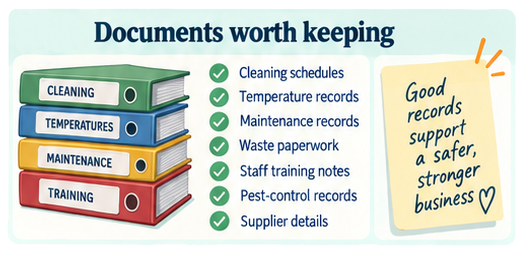
There are 14 regulated allergens, including milk, eggs, peanuts, tree nuts, cereals containing gluten, fish, crustaceans, molluscs, soya, sesame, celery, mustard, lupin and sulphites at regulated levels.
You need a reliable way of knowing exactly what ingredients are in the food you sell and communicating that information accurately to customers.
Do not rely on somebody remembering the recipe.
Create an allergen matrix or similar written system covering every menu item and keep ingredient information from suppliers.
The Food Standards Agency offers free online allergen training, complete with a downloadable CPD certificate. It is worthwhile completing even if you already have food hygiene training.
If you package food on the premises before the customer chooses it, such as sandwiches placed into a display fridge that morning, it may be classed as prepacked for direct sale, or PPDS.
Under what is commonly called Natasha’s Law, PPDS food must carry the food’s name and a full ingredients list, with allergens emphasised.
Allergen mistakes can be much more serious than merely receiving an unhappy review, so this is an area worth getting right from day one.
5. Make sure the premises are suitable
A beautiful counter and lovely logo will not compensate for a kitchen that cannot be cleaned properly.
Food premises must be kept clean, properly maintained and designed so that food can be prepared safely. Appropriate handwashing facilities, ventilation, lighting, drainage, food preparation surfaces, equipment and pest controls need to be considered.
Before signing a long commercial lease, speak to Denbighshire County Council Planning and Environmental Health.
A former clothes shop does not automatically have permission to become a takeaway. Planning permission may be required for a material change of use, and building regulations can also apply when altering a property.
This is particularly important where you intend to install extraction systems, commercial kitchens, structural alterations or major electrical and plumbing work.
Checking first is considerably cheaper than discovering the problem after spending £20,000 fitting the kitchen.
6. Expect a food hygiene inspection
Registering does not mean somebody hands you a hygiene rating immediately.
Denbighshire’s Environmental Health officers inspect food businesses. Visits can be unannounced and officers can examine how food is handled, the condition of the premises, your procedures and your records.
Following an inspection, qualifying businesses are rated from 0 to 5 under the Food Hygiene Rating Scheme.
In Wales, displaying your current food hygiene rating is a legal requirement.
Aiming for a 5 from the beginning is much easier than attempting to repair poor systems afterwards.
Clean premises matter, but inspectors also consider how well food safety is managed. Having good records, procedures and staff training can therefore be every bit as important as having a sparkling floor.
7. Sorting out waste
Commercial food waste cannot simply disappear into your household bin.
Businesses must arrange proper commercial waste disposal, either through Denbighshire County Council’s trade waste service or another appropriately licensed waste contractor. Domestic refuse services are not intended for business waste.
Wales also has workplace recycling rules requiring businesses to separate specified recyclable materials. Food businesses producing at least 5kg of food waste during a seven-day period must arrange for it to be separately collected. Food waste must not be disposed of into the sewer.
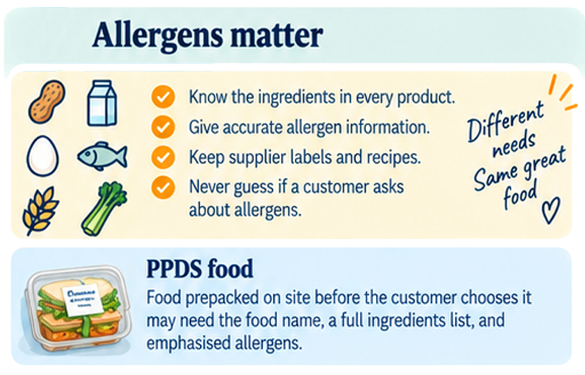
Keep your waste-transfer documentation too.
8. Fire, electrical, gas and first-aid safety
A commercial premises will normally require a fire risk assessment. In Wales, the responsible person must assess fire risks and keep the assessment and fire-safety arrangements appropriately recorded.
Your assessment might identify requirements for fire extinguishers, fire blankets, emergency lighting, alarms, evacuation procedures or other precautions depending upon the premises.
If you use commercial gas catering equipment, installation and relevant gas work should be undertaken by appropriately qualified Gas Safe registered engineers competent for that equipment.
Electrical equipment must also be maintained safely. One useful myth to squash here is that annual PAT testing of absolutely everything is not automatically required by law. The requirement is to keep electrical equipment safe, with inspection and testing based on risk.
For employees, you should also provide appropriate first-aid arrangements. Denbighshire advises that, at minimum, workplaces should have a suitably stocked first-aid kit and somebody appointed to take charge when first aid is required.
9. Insurance and employing people
If you employ staff, Employers’ Liability Insurance will normally be compulsory and must provide at least £5 million of cover.
For most food businesses it is also sensible to consider:
- Public liability insurance for accidents involving customers or members of the public.
- Product liability insurance for claims connected to products or food you have sold.
- Contents and equipment insurance for expensive refrigerators, coffee machines, ovens and stock.
- Business interruption insurance for situations where an insured incident prevents the business operating.
You will also need to deal with PAYE, employment rights, workplace pensions where applicable, right-to-work checks, employment contracts and health-and-safety responsibilities when taking on staff.
10. Selling food from home
The same food safety rules do not vanish because the kitchen happens to have your kettle and cereal cupboard in it.
Home food businesses still need to register at least 28 days before trading, implement food safety procedures, provide allergen information and ensure the food preparation environment is suitable.
You should also check whether you need permission from your landlord or mortgage provider, whether planning restrictions apply and whether your home insurance needs changing.
Environmental Health may visit the home as part of the food hygiene inspection process.
You do not necessarily need a completely separate commercial kitchen, but your domestic arrangements must allow the business to operate hygienically and safely.
Pets wandering through the kitchen during production, overflowing domestic fridges and ingredients with mysterious origins are unlikely to strengthen your case.
11. Mobile vans, stalls and pop-ups
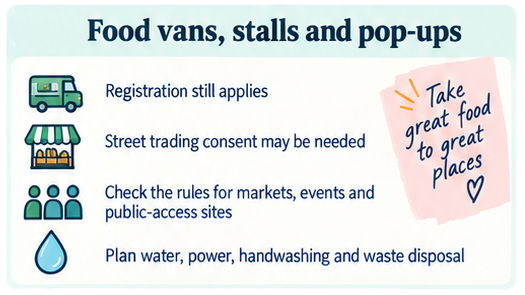
Selling from a food van or temporary stall still requires food business registration.
You may additionally require Street Trading Consent depending on where you intend to operate. In Denbighshire, consent can be required not only on streets but in places such as publicly accessible car parks, forecourts and some privately owned sites.
Requirements can differ for organised markets and events, so check with Denbighshire’s Licensing Team before committing to a location.
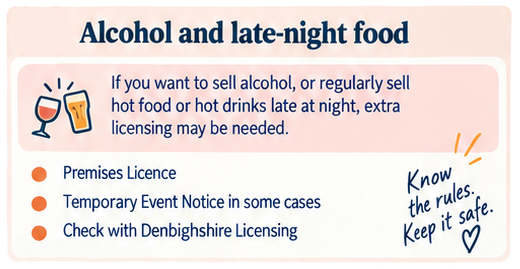
12. Alcohol and late-night food
A normal daytime café does not require a premises licence merely because it serves coffee and sandwiches.
Things change if you want to sell alcohol or regularly provide hot food or hot drinks between 11pm and 5am.
These activities can require a Premises Licence. Selling alcohol generally also requires an appropriate personal licence holder and Designated Premises Supervisor.
For occasional events, a Temporary Event Notice may sometimes be appropriate instead.
Apply through Denbighshire County Council Licensing.
13. Do I need special food-premises approval?
Most ordinary cafés, sandwich shops, ice cream parlours and home caterers will normally be dealing primarily with food-business registration.
Some businesses working with particular products of animal origin, especially certain manufacturing or supply arrangements, may additionally require formal food-premises approval before operating.
If you intend to manufacture meat products, dairy products, fish products or undertake significant supply to other businesses, discuss your plans with Denbighshire Environmental Health before starting.
Do not guess this one.
14. Experience: not compulsory, but extremely useful
There is no general rule saying you must have spent five years working in a café before opening one.
But some practical experience is invaluable.
Before investing serious money, consider spending time working, volunteering or shadowing in a busy food environment. Learning how to handle a lunchtime rush, receive deliveries, rotate stock, organise prep, deal with complaints and somehow discover that everybody wants a cappuccino simultaneously cannot really be replicated by watching three YouTube videos.
Useful experience includes customer service, stock control, ordering, basic bookkeeping, cooking and preparation, cleaning schedules, staff supervision and cash handling.
15. The highly recommended extras
Alongside the legal requirements, a small food business would benefit enormously from having:
- Level 2 Food Safety training for everybody regularly handling food
- Level 3 Food Safety training for the owner, manager or kitchen supervisor
- FSA allergen training for all relevant staff
- first-aid training
- a written allergen matrix
- fridge, freezer and cooking temperature records
- probe thermometer and sanitising wipes
- documented opening and closing checks
- cleaning schedules
- pest-control arrangements
- supplier and ingredient records
- stock rotation and date-labelling procedures
- staff illness and return-to-work procedures
- equipment servicing records
- public and product liability insurance
- written recipes and portion specifications
- staff induction and refresher training
- basic bookkeeping or accounting knowledge
- a business plan and realistic cash-flow forecast
Food handlers should also understand that vomiting, diarrhoea and certain other illnesses must be reported. Staff working around open food would normally remain away from such work for 48 hours after relevant symptoms have naturally stopped.
Where do I go for everything?
| What you need | Where to start |
|---|---|
| Food business registration | Food Standards Agency / GOV.UK |
| Food safety advice | Denbighshire County Council Environmental Health |
| SFBB food safety system | Food Standards Agency |
| Allergen training | Food Standards Agency free online training |
| Food hygiene training | Recognised training provider or ask Environmental Health for guidance |
| Food-premises approval | Denbighshire County Council |
| Planning permission | Denbighshire County Council Planning |
| Building Regulations | Denbighshire County Council Building Control |
| Alcohol / late-night licence | Denbighshire County Council Licensing |
| Street trading | Denbighshire County Council Licensing |
| Commercial waste | Denbighshire Trade Waste or licensed private contractor |
| Fire safety | Welsh Government guidance / North Wales Fire and Rescue Service |
| Gas equipment | Appropriately qualified Gas Safe registered engineer |
| Tax / self-employment | HMRC via GOV.UK |
| Limited company registration | Companies House |
| Employers’ Liability Insurance | Authorised commercial insurer |
| Business support | Business Wales |
A simple order to tackle it
If all of that still looks rather large, reduce it to a journey.
First, decide exactly what food you want to sell and where you want to sell it.
Second, speak to Denbighshire Environmental Health and Planning before spending heavily on premises or equipment.
Third, register the food business at least 28 days before you intend to begin trading.
Fourth, complete appropriate food-safety and allergen training.
Fifth, build your food-safety system using resources such as Safer Food, Better Business.
Sixth, prepare the premises, equipment, cleaning systems, allergen information, waste arrangements, insurance and safety procedures.
Finally, open the doors, maintain those standards every day and treat your food hygiene rating as part of your reputation rather than simply another sticker for the window.
Starting a food business certainly involves paperwork, but none of it is designed to make the dream impossible. For a small operator, much of the process comes down to knowing your food, keeping things clean, recording what matters, understanding allergens, using safe equipment and asking the council when you are unsure.
The aim is not to become a food-law solicitor before selling your first sandwich.
It is simply to demonstrate that you know what you are doing, have thought about the risks and can confidently provide customers with food that is safe, accurately described and professionally prepared.
Information checked against current Food Standards Agency, Welsh Government and Denbighshire County Council guidance in September 2026.

Join The Discussion