Business rates can look unnecessarily complicated.
You find a commercial property with a rateable value (RV) of £9,000, somebody mentions a multiplier, somebody else says the business may receive a 50% relief, another person talks about a special retail rate, and before long the calculator has been quietly pushed to the other side of the desk.
The good news is that the basic system is quite logical.
For most businesses, the journey looks like this:
Rateable Value (RV) × the correct multiplier = basic business rates liability
Then:
Basic liability − any eligible reliefs = the amount you need to pay
There are exceptions and additional schemes, but understanding those two stages makes everything else considerably easier.
This guide explains how business rates work in Denbighshire using the 2026/27 Welsh business rates system, which came into effect on 1st April 2026.
First things first: what are business rates?
Business rates, officially known as Non-Domestic Rates (NDR), are a tax on most properties used for business and other non-domestic purposes.
They can apply to shops, cafés, offices, warehouses, workshops, pubs, factories and many other commercial premises.
In Denbighshire, the bill is issued and collected by Denbighshire County Council (DCC), but the council does not simply decide how much it would like a business to pay.
Business rates collected by Welsh councils are paid into a national pool and redistributed as part of the funding arrangements for local services.
Several different organisations therefore play a part.
The Valuation Office Agency (VOA), part of HMRC, determines the rateable value and description of the property.
The Welsh Government sets the business rates multipliers and establishes national relief schemes.
Denbighshire County Council uses that information to calculate the bill, administer eligible reliefs and collect the amount due.
That distinction is important. Denbighshire County Council does not set the Rateable Value and does not choose the national multiplier.
What is a Rateable Value?
The rateable value, is one of the most misunderstood figures in commercial property.
It is not your annual business rates bill.
It is also not necessarily the rent that the landlord is currently charging.
Instead, it represents an estimate of the annual rent the property could reasonably have achieved on the open market at a particular valuation date.
The current Welsh rating list came into effect on 1st April 2026. The values are based on the property market as it stood on 1st April 2024.
For example, imagine a shop has:
Rateable Value: £10,000
That does not mean the business automatically pays £10,000 per year in rates.
The £10,000 is simply the starting figure used in the calculation.
Where can I find a property’s Rateable Value?
You can search for the rateable value of commercial premises using the government’s Find a Business Rates Valuation service.
The service allows you to search properties in England and Wales and can also show how a valuation was calculated and the valuations of similar premises.
Denbighshire County Council also provides access to rateable value information through its business rates pages.
If you believe the RV or description of a property is incorrect, the matter should normally be raised with the Valuation Office Agency rather than the council.
What is the multiplier?
Once you know the rateable value, you need the second ingredient: the multiplier.
Think of the multiplier as the percentage-like figure that turns the RV into the starting business rates bill.
For example:
(RV) £20,000 × (multiplier) 0.502 = £10,040
A multiplier of 0.502 effectively means paying 50.2 pence for every £1 of rateable value, before any reliefs are applied.
The multiplier is set by the Welsh Government, not by Denbighshire County Council.
The three Welsh multipliers for 2026/27
This is one of the biggest changes to the Welsh business rates system.
Until 31st March 2026, Wales generally used a single multiplier. For 2025/26 it was 0.568.
From 1st April 2026, Wales introduced three different multipliers.
| Multiplier | 2026/27 rate | Generally applies to |
|---|---|---|
| Retail multiplier | 0.350 | Qualifying small and medium-sized retail shops with RV below £51,000 |
| Standard multiplier | 0.502 | Most other properties |
| Higher multiplier | 0.515 | Most properties with RV above £100,000 |

The retail multiplier is particularly interesting.
Qualifying properties must generally have an RV below £51,000 and be described on the rating list as a shop and premises, kiosk and premises, pharmacy and premises, post office and premises, or shop, post office and premises.
It is aimed at businesses primarily selling goods to visiting members of the public.
However, it does not automatically include every business on a high street. Banks, salons and similar service businesses are excluded, as are cafés, pubs and restaurants where food or drink is consumed on the premises.
The difference is substantial.
A qualifying shop with an RV of £20,000 would start with:
£20,000 × 0.350 = £7,000
A normal property with the same RV using the standard multiplier would start with:
£20,000 × 0.502 = £10,040
That is a difference of £3,040 before any other reliefs are considered.
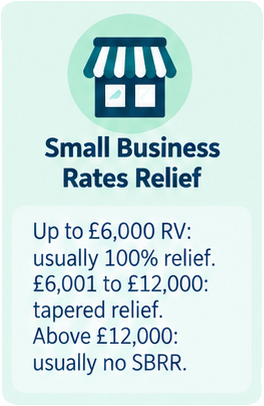
Small Business Rates Relief
Small Business Rates Relief (SBRR), can reduce the bill even further.
For qualifying Welsh properties:
| Rateable Value | Typical SBRR |
|---|---|
| Up to £6,000 | 100% |
| £6,001 to £12,000 | Tapered from 100% to zero |
| Above £12,000 | Normally 0% |
The relief is normally automatically applied to eligible accounts.
There are eligibility conditions, and a business can generally receive SBRR on a maximum of two qualifying properties within each local authority area.
To make the taper easier to visualise, an RV of around £9,000 receives approximately 50% relief.
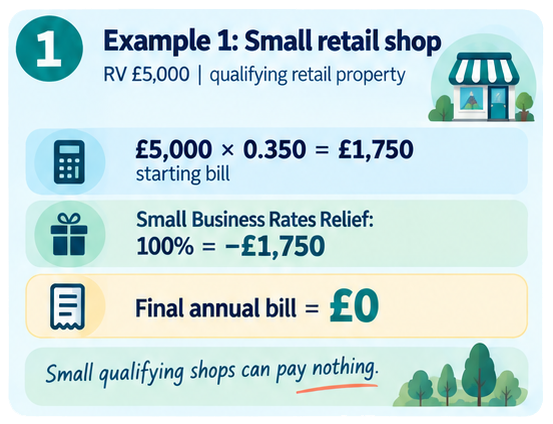
Example 1: Small retail shop
Imagine a small shop in Rhyl has: RV: £5,000
Because it qualifies for the retail multiplier: £5,000 × 0.350 = £1,750
It also qualifies for 100% Small Business Rates Relief.
So: £1,750 − £1,750 relief = £0
Approximate annual business rates: £0
This is why seeing a Rateable Value of £5,000 should not be interpreted as meaning the tenant has to pay £5,000 per year.
Example 2: Retail shop
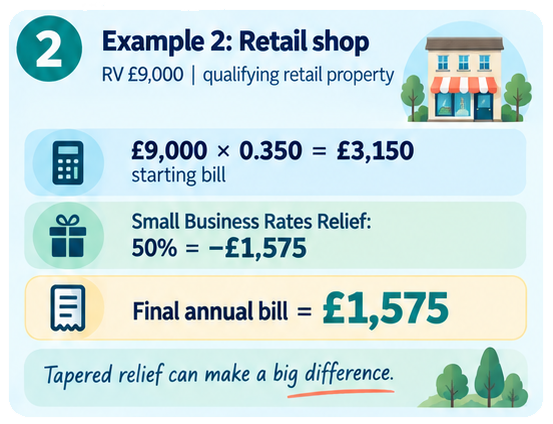
Now imagine another qualifying shop: Rateable Value: £9,000
First apply the retail multiplier: £9,000 × 0.350 = £3,150
At an RV of £9,000, the property receives approximately 50% Small Business Rates Relief.
£3,150 × 50% = £1,575 relief
Therefore: £3,150 − £1,575 = £1,575
Approximate annual bill: £1,575
The official Welsh Government examples use this same calculation.
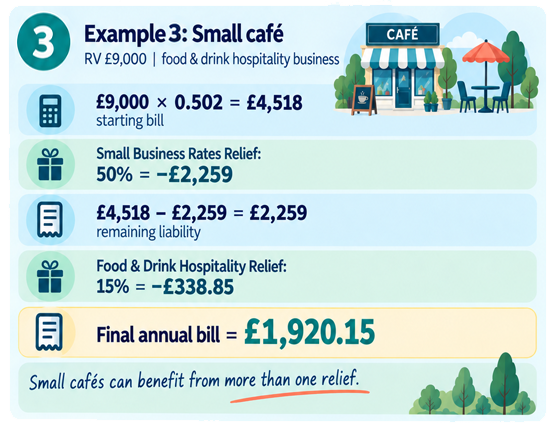
Example 3: Small café
A café has: RV: £9,000
It uses the standard multiplier: £9,000 × 0.502 = £4,518
It is also small enough to receive approximately 50% SBRR: £4,518 − £2,259 = £2,259
Now apply the 15% Food and Drink Hospitality Rates Relief to the remaining liability: £2,259 × 15% = £338.85 relief
So: £2,259 − £338.85 = £1,920.15
Approximate annual bill: £1,920.15
This demonstrates an important point: different reliefs can interact.
The hospitality relief is applied to the remaining bill after applicable mandatory and certain other reliefs have already been taken into account.
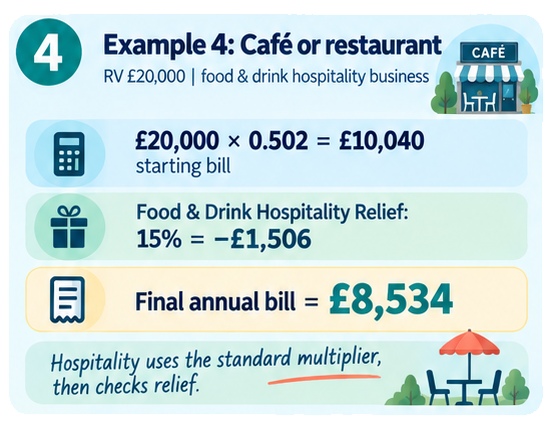
Example 4: Café or restaurant
Let’s suppose the Rateable Value is: £20,000
Standard multiplier: £20,000 × 0.502 = £10,040
There is no normal SBRR, because the RV exceeds £12,000.
However, if the business qualifies for hospitality relief: £10,040 × 15% = £1,506
Therefore: £10,040 − £1,506 = £8,534
Approximate annual bill: £8,534
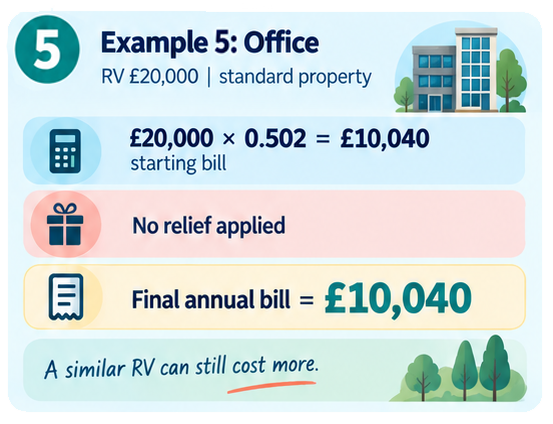
Example 5: Office
Now consider an office with: RV: £20,000
It does not qualify for the retail multiplier and is above the SBRR threshold.
Therefore: £20,000 × 0.502 = £10,040
Assuming no other relief applies.
Approximate annual bill: £10,040
The same Rateable Value can therefore produce very different final bills depending on the property’s use and the reliefs available.
What about cafés, restaurants and pubs?
Hospitality works slightly differently.
A café does not normally qualify for the special 0.350 retail multiplier simply because it sells products to customers.
Instead, qualifying food and drink hospitality businesses use the appropriate normal multiplier and can then receive a separate Food and Drink Hospitality Rates Relief.
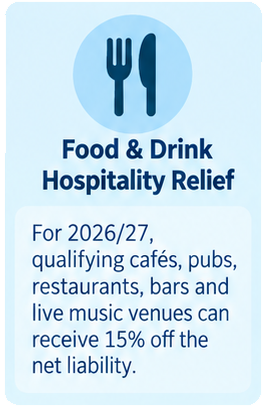
For 2026/27, qualifying occupied pubs, restaurants, cafés, bars and live music venues can receive 15% off their remaining business rates liability.
The maximum amount available is £110,000 per business across its eligible Welsh properties. Applications must be made to the relevant local authority by 31 March 2027.
Hotels, holiday accommodation, shops, cinemas and many other property types are not included simply because they are sometimes described broadly as hospitality or leisure businesses.
Other reliefs worth knowing about
Small Business Rates Relief and hospitality relief are not the only help available. Depending on the property and organisation, other schemes include:
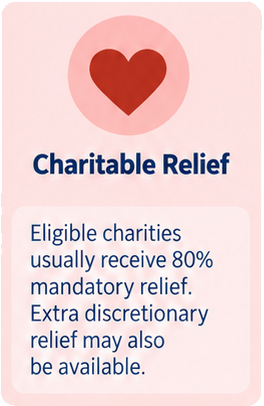
- Charitable relief: qualifying charities using premises wholly or mainly for charitable purposes normally receive 80% mandatory relief, with the council having discretion over some or all of the remaining 20%.
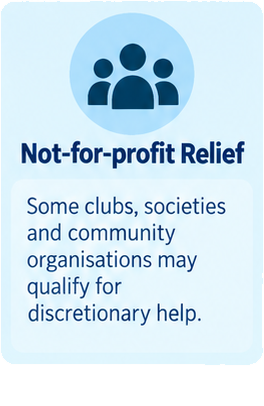
- Not-for-profit relief: Denbighshire County Council can award discretionary relief to qualifying organisations involved in areas such as charitable activity, education, social welfare, recreation, science or the arts.
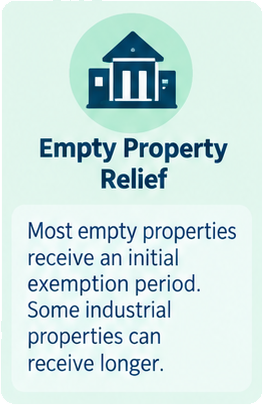
- Empty Property Relief: most empty business premises receive an initial three-month exemption. Industrial properties such as warehouses can normally receive a further three months. Certain other properties may remain exempt for longer.
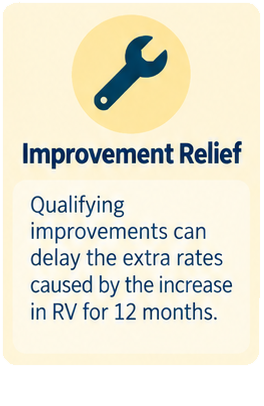
- Improvement Relief: qualifying improvements that increase a property’s RV can receive relief from that increase for 12 months, allowing the business time to benefit from its investment before the higher rates liability takes effect. The scheme is currently available for qualifying improvements through 31 March 2029.
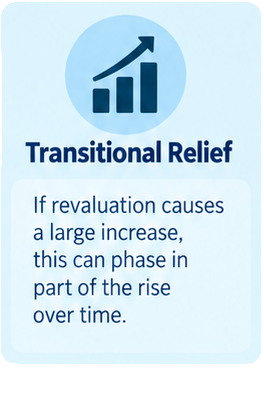
- Transitional Relief: if the 2026 revaluation increased an eligible property’s liability by more than £300, the increase can be phased in. Eligible businesses generally pay 33% of the additional liability in 2026/27, 66% in 2027/28 and the full amount from 2028/29.
- Part occupation relief: where part of a property is temporarily unused, the council may ask the Valuation Office to divide the valuation between occupied and unoccupied areas.
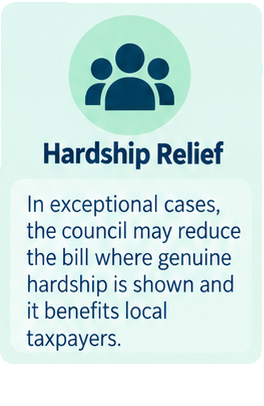
- Hardship relief: Denbighshire County Council has discretionary powers to reduce rates in exceptional circumstances where paying the full bill would cause genuine hardship and granting relief is considered to be in the interests of local taxpayers.
There are also specialist provisions covering areas such as heat networks and qualifying green plant and machinery.
From Rateable Value to final bill
So when you are looking at a commercial property in Denbighshire, work through it in this order:
Find the Rateable Value
↓
Check the property’s official rating-list description
↓
Choose the correct multiplier
↓
Rateable Value × multiplier
↓
Check Small Business Rates Relief
↓
Check sector-specific or other reliefs
↓
Check transitional relief where applicable
↓
Arrive at the final annual liability
↓
Denbighshire County Council issues the actual bill
That is the whole journey.
A rateable value is therefore best thought of as the starting line, not the finishing line.
How do you actually pay?
Once all calculations and reliefs have been applied, Denbighshire County Council issues the business rates bill.
Payments can be made through methods including Direct Debit, online payment, card, standing order and other available payment methods.
Direct Debit customers can currently choose payment dates including the 4th, 15th, 22nd or 30th of the month, while monthly payments not made by Direct Debit are normally due on the 5th.
If a business is struggling to make payments, it is always better to contact the council early rather than simply allowing arrears to build.
The important thing to remember
Business rates can look intimidating because several numbers are displayed at once, but the fundamentals are fairly straightforward.
Your RV is not your bill.
The Valuation Office Agency establishes the RV.
The Welsh Government establishes the multiplier.
Denbighshire County Council calculates and collects the resulting charge and administers relief.
And reliefs can make an enormous difference.
A £9,000 RV property might produce a starting bill of £4,518 under the standard multiplier, £3,150 using the retail multiplier, or considerably less once Small Business Rates Relief and other qualifying support are included.
In some cases the final figure can even be £0.
So if you are considering taking on a commercial property, do not stop when you see the Rateable Value.
Check the multiplier.
Check the reliefs.
Check the property’s official classification.
Then do the calculation.
What first appears to be a wall of tax terminology often turns into a fairly short piece of arithmetic once everything is placed in the right order.